
Ecommerce Marketing Agency in Surat
Grow your online store across acquisition, conversion and retention. Growth Mind Digital helps ecommerce and D2C brands build measurable growth strategies using Google Ads, Meta Ads, ecommerce SEO, CRO, remarketing, WhatsApp and better marketing analytics.
Acquire • Convert • Retain • Measure

Ecommerce growth is not one marketing channel
An online store can run great ads and still struggle if product pages are weak. It can rank in Google and still lose customers at checkout. It can acquire first-time buyers and still have poor economics if nobody comes back.
The system has to work together
Acquire: bring relevant shoppers through paid media, search and content.
Convert: help visitors move from product discovery to purchase with less friction.
Retain: create reasons and channels for customers to buy again.
Measure: understand revenue, customer acquisition cost, ROAS, conversion rate, average order value and repeat behaviour.
Our ecommerce marketing approach connects these stages instead of treating each channel as a separate dashboard.
Ecommerce marketing services in Surat
We work across the parts of ecommerce marketing that directly influence customer acquisition, conversion, retention and decision-making.
Performance Marketing
Google Ads, Meta Ads, Shopping, Performance Max, remarketing and paid social designed around store economics rather than clicks alone.
Ecommerce SEO
Category, collection, product and technical SEO to build more durable organic demand.
Conversion Optimization
Improve product pages, cart, checkout, forms and mobile shopping journeys to reduce friction.
Retention & Remarketing
Reconnect with visitors and existing customers through remarketing, WhatsApp and lifecycle thinking.
Analytics & Tracking
Measure purchases, conversion value, product performance and the economics behind growth.
Ecommerce performance marketing
Performance marketing for ecommerce should connect media spend with product demand, conversion value and customer economics.
We look beyond impressions and clicks to understand whether paid traffic is producing orders at an acquisition cost the business can sustain.
Depending on the brand, that can mean balancing customer acquisition cost, ROAS, margin, conversion rate and repeat purchase potential rather than optimizing one metric in isolation.
The questions behind the ad spend
- Which products deserve more budget?
- Which products attract new customers?
- Which campaigns are profitable after margin?
- Are we measuring real purchase value?
- Is creative fatigue increasing acquisition cost?
- Are first-time buyers coming back?
- Can the store convert more of the traffic we already pay for?
Meta Ads for ecommerce & D2C brands
Facebook and Instagram can help ecommerce brands create demand, introduce products, reach new audiences and reconnect with people who have already engaged with the store.
But paid social performance depends heavily on the combination of product, offer, creative and landing experience.
Creative is part of media buying
For ecommerce campaigns, we may work with product demonstrations, benefit-led ads, problem-solution angles, UGC-style content, testimonials, static creatives, carousels, Reels and offer-led campaigns.
We test creative angles because audiences do not respond to every product in the same way. A strong account needs more than one ad that runs indefinitely.
Remarketing can also support product viewers, cart visitors and other high-intent audiences where platform policies and available signals allow.

Google Ads for ecommerce
Google can capture shoppers who are already searching for products, categories or brands. Depending on the store, the strategy may include Search campaigns, Shopping inventory, Performance Max and remarketing.
We focus on the relationship between product demand, Merchant Center data, conversion value and store profitability rather than simply pushing every SKU into the same campaign.
Google Shopping & Performance Max
Shopping-led campaigns can put product images, prices and store information directly in front of users comparing what to buy.
Performance Max can expand product-led advertising across Google inventory, but automation works best when conversion tracking, product data and business goals are clear.
Google Merchant Center & product feeds
Product feeds influence how Google understands your catalog. We may review titles, descriptions, images, pricing, availability, identifiers, categories and feed errors.
Feed optimization is not glamorous, but better product data can improve relevance and give advertising systems cleaner information to work with.
D2C marketing for Surat brands
Direct-to-consumer brands need more than customer acquisition. They need a model where the cost of acquiring a buyer makes sense relative to what that buyer is worth over time.
Acquisition is only the first purchase
D2C growth can involve product positioning, creative testing, Meta Ads, Google Ads, ecommerce SEO, conversion optimization, remarketing, retention and post-purchase communication.
The strongest brands usually think beyond one transaction and ask whether first-time buyers return, whether customer acquisition cost is sustainable and which products create the best long-term customer relationships.
This is particularly relevant for Surat businesses in fashion, textiles, jewellery, beauty, home products and other consumer categories.
Ecommerce SEO in Surat
Ecommerce SEO is different from optimizing a five-page service website. Stores may have hundreds or thousands of product, category and filter URLs, which creates different technical and content challenges.
We look at how customers search for products and how the store architecture supports category, collection and product discovery.
What ecommerce SEO may involve
- Category and collection pages
- Product page SEO
- Commercial keyword research
- Internal linking
- Product schema
- Indexation and crawlability
- Duplicate or thin content
- Faceted navigation
- Product descriptions
- Content that supports product discovery
Shopify marketing
For Shopify brands, marketing can connect product feeds, Meta and Google advertising, analytics, SEO, conversion optimization and retention channels.
We focus on the growth layer around the store: attracting the right customers, measuring purchases and improving the customer journey.
WooCommerce marketing
WooCommerce gives WordPress-based stores flexibility across content, SEO and ecommerce. We can support acquisition and growth through paid media, SEO, conversion optimization, analytics and remarketing around the store.
For larger development or structural changes, this can connect with our website development services.
Ecommerce conversion rate optimization
Getting more traffic is expensive if the store makes it unnecessarily hard for people to buy.
Ecommerce CRO looks at the journey from product discovery to completed checkout and identifies where shoppers hesitate, abandon or become confused.
Where conversion friction can appear
- Category and collection pages
- Product pages
- Variant selection
- Product information
- Add-to-cart experience
- Cart
- Checkout
- Shipping information
- Payment options
- Mobile usability
- Page speed
We prioritize the changes that have a plausible connection to customer behaviour rather than redesigning the store simply to make it look different.
Product page optimization
Product pages need to answer the questions that stop a shopper from buying.
Depending on the category, that can mean stronger images, clearer descriptions, size or specification information, reviews, price presentation, variants, delivery expectations, returns, trust and more visible add-to-cart actions.
Category & collection page optimization
Category pages help shoppers discover the right products without becoming overwhelmed.
Useful improvements may include better filtering, merchandising, product sorting, stronger category copy, internal links and clearer visual hierarchy.
These pages can also play an important role in ecommerce SEO.
Cart & checkout optimization
A shopper who reaches checkout has already moved through several stages of intent. Unnecessary friction at this point can be expensive.
Common checkout friction
- Unexpected shipping costs
- Too many fields
- Forced account creation
- Limited payment options
- Confusing coupon behaviour
- Poor mobile usability
- Unclear delivery expectations
- Technical errors
- Weak trust signals
We look at checkout in context. Removing useful information can be just as harmful as adding unnecessary steps.
Ecommerce remarketing & retargeting
Most shoppers do not buy during their first interaction with a brand.
Remarketing can help reconnect with people who viewed products, browsed categories, added items to cart or otherwise showed relevant interest.
The message should reflect what the customer already knows instead of repeating the same prospecting ad indefinitely.
Different intent deserves different messaging
A new visitor may need product education. A product viewer may need proof. A cart abandoner may need reassurance around delivery, payment or returns. An existing customer may respond better to complementary products or a replenishment message.
Better segmentation makes remarketing more useful and less repetitive.
Ecommerce retention marketing
The first order is not always where the economics of ecommerce become attractive.
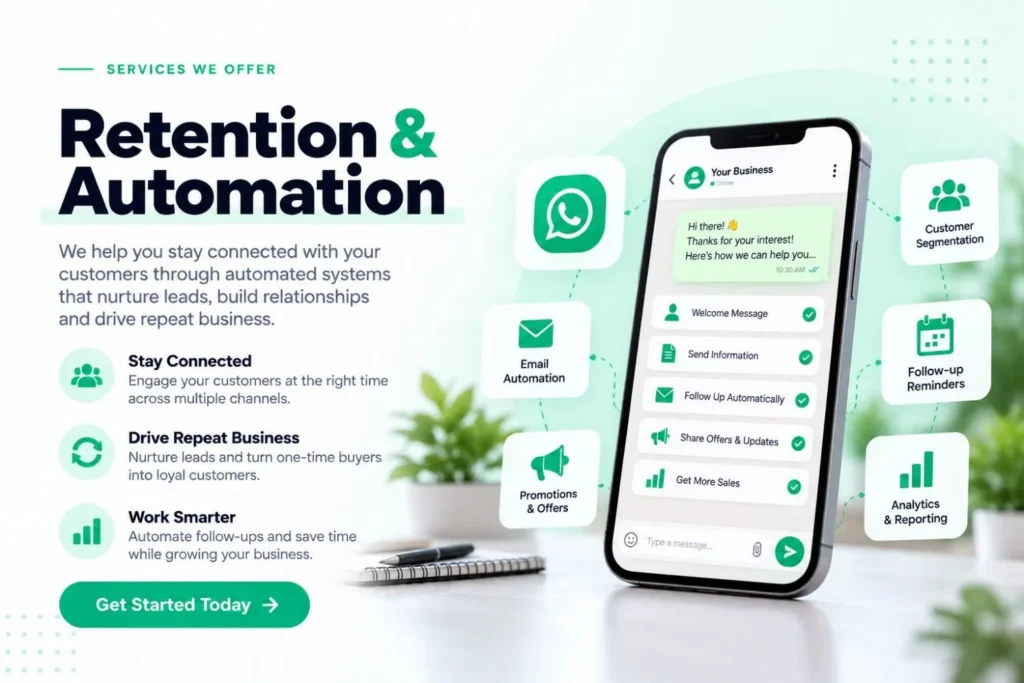
Retention marketing focuses on increasing the value of the customer relationship after acquisition. Depending on the brand, this can include post-purchase communication, replenishment, win-back offers, complementary products, customer segmentation and repeat-purchase campaigns.
Retention matters most when the product naturally supports repeat buying. It should not be forced where the customer genuinely has no reason to purchase again.
WhatsApp marketing for ecommerce
WhatsApp can support ecommerce communication around product discovery, order questions, abandoned journeys, repeat purchases and selected promotions where the customer has given appropriate consent.
For Indian ecommerce businesses, it can be a particularly natural customer channel when used carefully rather than as a broadcast spam tool.
Email & lifecycle thinking
Email can play a similar lifecycle role through welcome journeys, abandoned-cart reminders, post-purchase communication, product education, replenishment and win-back campaigns.
Where email implementation is part of the wider stack, the strategy should connect with customer segments and purchase behaviour instead of sending the same campaign to everyone.
Ecommerce creative strategy
For paid social especially, creative is one of the biggest performance variables.
Build a pipeline of angles, not one “winning ad” forever
Useful creative angles can include product demonstration, problem-solution, benefits, before-and-after where appropriate, testimonials, founder stories, UGC-style content, comparison, educational content and offer-led messaging.
We look at which hooks attract attention, which product benefits create interest and whether creative fatigue is increasing customer acquisition cost.
Creative testing should produce learning that informs the next round of ads.
Ecommerce content marketing
Content can support both discovery and purchase confidence.
Depending on the store, useful ecommerce content may include buying guides, comparisons, product education, category content, use cases, care guides, FAQs and social content.
Content should help customers make better buying decisions rather than exist only to add words to the website.
Content also supports SEO & paid media
Search content can attract people earlier in the buying journey. Strong product education can improve ad creative. FAQs can reduce pre-purchase uncertainty. Customer stories can strengthen social proof.
The most useful ecommerce content often serves more than one channel.
Ecommerce analytics & conversion tracking
Revenue-focused marketing requires accurate measurement. If purchases, values or key funnel events are missing or duplicated, marketing decisions become unreliable.
What we may track
- Product views
- Add to cart
- Begin checkout
- Purchases
- Purchase value
- Product-level performance
- Campaign revenue
- Important customer actions
Depending on the stack, this can involve GA4, Google Tag Manager, Google Ads, Meta Pixel and platform-native ecommerce tracking.
Ecommerce marketing metrics that matter
Revenue is important, but revenue alone does not tell you whether growth is healthy.
Acquisition & conversion
ROAS: revenue generated relative to advertising spend.
CAC: what it costs to acquire a new customer.
CPA: cost of the defined acquisition event.
Conversion Rate: the percentage of relevant sessions or users who complete the desired purchase action.
Order value & retention
AOV: average order value.
LTV / CLV: estimated value of a customer relationship over time.
Repeat Purchase Rate: how often customers return.
Revenue per Visitor: how effectively store traffic translates into revenue.
Metrics should be interpreted alongside margin and product economics.
Launching a newer ecommerce brand
Early-stage stores usually need a reliable foundation before aggressive scaling.
- Accurate tracking
- Clear product positioning
- Store readiness
- Initial creative
- Meta and/or Google acquisition
- Product feed basics
- Early conversion improvements
- Basic retention setup
The first objective is to learn which products, offers and audiences show genuine commercial potential.
Scaling an established ecommerce brand
Scaling introduces different problems.
- Rising customer acquisition cost
- Creative fatigue
- Budget allocation
- Product-level profitability
- Channel diversification
- CRO
- Retention
- LTV
- Inventory constraints
Growth should be evaluated against margin, cash flow and customer economics rather than revenue screenshots alone.

Ecommerce marketing for Surat brands & industries
Surat has strong product-led industries, but each category needs different merchandising, creative and customer-acquisition logic.
Textile & fashion ecommerce
Fashion, garments, sarees, fabrics and lifestyle brands may rely heavily on visual creative, catalog depth, variants, sizing, product feeds and repeat seasonal demand.
Jewellery ecommerce
Jewellery stores need strong visual presentation, trust, product detail, remarketing and a clear strategy for high-consideration purchases.
Beauty & personal care
Education, UGC-style creative, repeat purchase, bundles and retention can all play significant roles.
Home, decor & lifestyle
Product imagery, room-use context, Shopping, remarketing and product discovery are often important.
Manufacturers going D2C
Manufacturers moving direct to consumer may need help repositioning products for end customers rather than relying on B2B language and trade relationships.
Ecommerce growth for Surat businesses
Growth Mind Digital works from Surat and understands the mix of product businesses operating across areas such as Vesu, Adajan, Pal, Piplod, City Light, Athwa, Varachha, Katargam, Udhna, Ring Road and the wider Surat business ecosystem.
For ecommerce, the customer market is often much larger than the local area. Strategy may target Gujarat, India-wide or international buyers depending on the store, logistics and product economics.
Your own store vs marketplaces
Amazon, Flipkart, Meesho, Myntra, AJIO and other marketplaces can be important sales channels for some ecommerce businesses.
Your own store gives you more control over branding, customer experience and first-party customer relationships, while marketplaces can provide built-in demand and discovery.
Use channels based on your actual model
We do not position marketplace account management as a default service unless it is specifically part of the agreed scope.
Our core ecommerce marketing work focuses on the channels and conversion systems we can actively manage well, including your store, paid media, SEO, CRO, tracking, remarketing and retention.
Our ecommerce marketing process
Understand the economics, build the measurement foundation, acquire customers, improve conversion and strengthen retention.
Understand
We review products, margins, customer value, positioning, audience, logistics and growth goals.
Measure
We verify purchase tracking, conversion value and the events needed for useful decisions.
Acquire
Use the right mix of Google, Meta, SEO and content based on how customers discover the product.
Test
Learn which products, creatives, audiences and offers show the strongest commercial signals.
Convert
Improve product pages, categories, cart, checkout and landing experiences where friction exists.
Retain
Build remarketing and lifecycle journeys that make sense for the product and customer.
Analyze
Review CAC, ROAS, conversion rate, AOV, repeat behaviour and product-level performance.
Improve
Use the evidence to guide the next highest-value growth decision.
What we look at before scaling ad spend
More budget magnifies both what is working and what is broken.
Product margin: can the economics support paid acquisition?
Conversion tracking: are purchase value and key events accurate?
Inventory: can winning products stay in stock?
Store conversion: does the site handle more traffic effectively?
Creative supply: can the brand continue producing useful new ads?
Retention: do customers have a natural reason to buy again?
Fulfilment: can operations support the increase in orders?
Why choose Growth Mind Digital as your ecommerce marketing agency in Surat?
We look at ecommerce as a connected growth system rather than a collection of disconnected channels.
Acquisition + conversion
We can connect paid-media strategy with the pages, products and store experiences that receive the traffic.
SEO + performance marketing
Short-term acquisition and longer-term organic visibility can support each other rather than compete for attention.
CRO + retention thinking
We care about what happens after the click and after the first order, not only the acquisition dashboard.
Connected specialist services
Growth Mind Digital also works across Google Ads, Meta Ads, SEO, conversion rate optimization, landing pages, website development and WhatsApp marketing.
Ecommerce marketing pricing in Surat
Ecommerce marketing scope can vary significantly. Pricing may depend on ad spend, number of platforms, catalog size, campaign complexity, creative requirements, SEO scope, conversion work, analytics, tracking, retention and reporting.
A growing D2C brand with hundreds of products and multi-channel media needs a different level of work from a smaller store validating its first acquisition channel.
We prefer to understand the store economics and growth stage before recommending the right scope.
No guaranteed ROAS or revenue promises
We do not promise a guaranteed ROAS, fixed customer acquisition cost or guaranteed revenue increase.
Ecommerce performance depends on product demand, margin, pricing, competition, creative, store experience, inventory, seasonality, fulfilment and many other factors.
Our role is to build a clearer strategy, improve measurement, test intelligently and keep allocating effort toward what the evidence suggests is working.
Frequently asked questions about ecommerce marketing
What does an ecommerce marketing agency do?
An ecommerce marketing agency helps online stores acquire customers, improve conversion, measure performance and strengthen retention. Services can include paid media, SEO, CRO, analytics, remarketing and lifecycle marketing.
Which marketing channel is best for ecommerce?
There is no single best channel. Google can capture existing search demand, Meta can create and scale demand through creative, SEO can build organic discovery, and retention channels can increase repeat purchases. The right mix depends on the product and customer journey.
Is Google Ads good for ecommerce?
It can be very effective for products with search demand, particularly through Shopping, Performance Max and Search. Performance depends on feed quality, competition, conversion tracking, store experience and product economics.
Are Meta Ads good for ecommerce?
Meta Ads can work well for visual and discovery-led products, especially when the brand can produce strong creative. Results depend on offer, audience, creative, tracking and the store experience after the click.
What is Performance Max for ecommerce?
Performance Max is a Google Ads campaign type that can use inventory across multiple Google properties. For ecommerce it often works with Merchant Center product data and conversion value signals.
What is ecommerce SEO?
Ecommerce SEO focuses on helping product, category and store pages become more discoverable in organic search while managing technical issues such as large catalogs, duplicate URLs, internal linking and indexation.
Can you market Shopify stores?
Yes. We can support growth around Shopify stores through paid media, SEO, tracking, CRO and retention strategy depending on the project scope.
Can you market WooCommerce stores?
Yes. We can work with WooCommerce stores across paid acquisition, SEO, conversion optimization, analytics and remarketing.
What is ROAS?
ROAS means return on ad spend. It compares revenue attributed to advertising with the amount spent on ads. It is useful, but should be interpreted alongside margin, customer acquisition cost and business profitability.
What is CAC in ecommerce?
CAC means customer acquisition cost. It estimates how much it costs to acquire a new customer. It becomes more meaningful when compared with margin, repeat purchase and customer lifetime value.
How can I increase my ecommerce conversion rate?
Possible improvements include stronger product pages, clearer pricing and shipping information, better mobile usability, more trust, less checkout friction, better product discovery and more relevant traffic. The right change depends on the evidence.
How can I reduce cart abandonment?
Start by understanding why customers abandon. Common causes can include shipping surprises, payment friction, technical errors, forced account creation, confusing checkout or uncertainty around delivery and returns.
Can WhatsApp help ecommerce retention?
Yes, where customers have appropriate consent and the communication is useful. WhatsApp can support product questions, order communication, replenishment, repeat purchases and selected promotions.
Do you manage Amazon and Flipkart?
Marketplace account management is not positioned as a default part of our ecommerce service. If a marketplace requirement is relevant, we define clearly what is and is not included before the project begins.
How much do ecommerce marketing services cost in Surat?
Pricing depends on channels, catalog size, media spend, creative needs, SEO, CRO, tracking, retention and reporting. We recommend scoping the work after reviewing the store and growth stage.
Build an ecommerce growth system, not just another ad campaign
Acquire the right customers, improve the store experience, strengthen retention and measure the economics behind growth.
Meta Ads • Google Shopping & PMax • Ecommerce SEO • CRO • Remarketing • Retention • Analytics