
Email Marketing Agency in Surat
Build email campaigns and automated customer journeys that stay useful after the first click or first purchase. Growth Mind Digital helps Surat businesses plan permission-based email marketing for newsletters, lead nurturing, ecommerce retention, launches, follow-up and lifecycle communication.
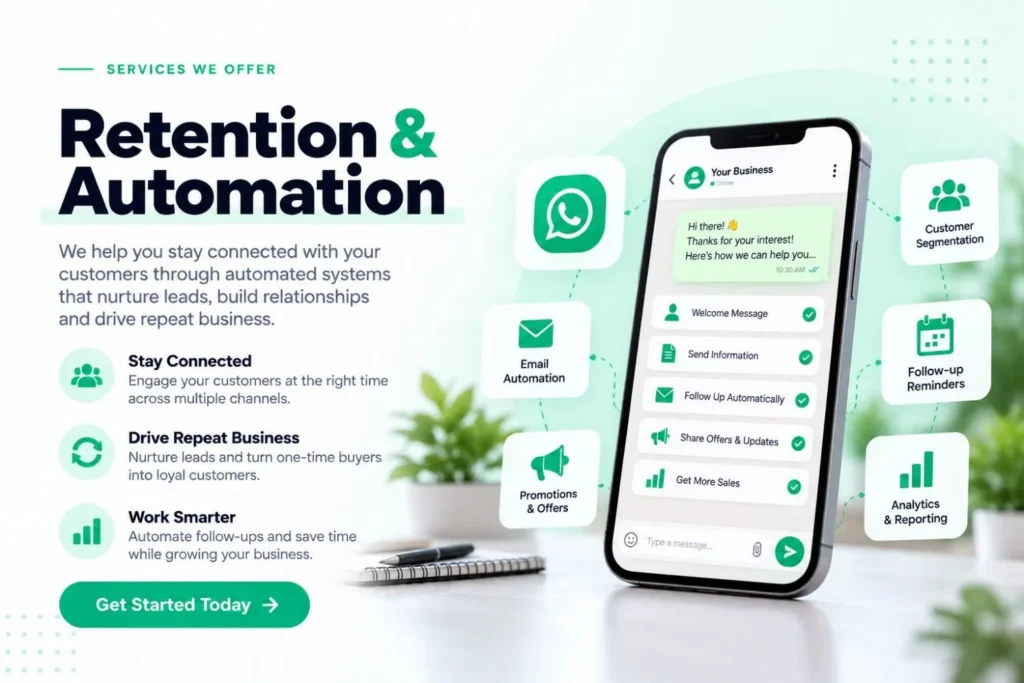
Email gives your business a direct relationship with the audience
Social platforms and advertising channels can help you reach people, but your access to those audiences depends on the platform.
A healthy email list becomes an owned communication asset
When customers and prospects have knowingly subscribed, email gives the business a way to continue the relationship through useful content, offers, product education, reminders and lifecycle communication.
The objective is not to send as many emails as possible. It is to send messages that are relevant enough that people choose to keep receiving them.
That makes list quality, segmentation, content and deliverability as important as campaign frequency.
Email marketing services for Surat businesses
Email marketing includes the strategy, copy, design, segmentation, automation, sending and analysis used to communicate with people who have an appropriate relationship or permission to receive business emails.
It can support customer acquisition, lead nurturing, ecommerce sales, retention, education and long-term brand relationships, depending on the business model.
Our email marketing services in Surat
We build the email program around the customer journey rather than treating every subscriber as one large broadcast list.
Email Strategy & Planning
Define audience segments, campaign goals, lifecycle stages, content themes and a realistic sending rhythm.
Campaigns & Newsletters
Create useful promotional, educational and relationship-building emails for subscribed audiences.
Email Automation
Build triggered journeys for welcomes, lead nurture, ecommerce, post-purchase communication and re-engagement.
Copy & Email Design
Develop subject lines, body copy, calls to action and mobile-friendly layouts that support the message.
Testing, Analytics & Deliverability
Measure engagement and business outcomes while improving list health, authentication and sending practices.
Permission-based email marketing
Strong email marketing begins before the first campaign is sent. People should know why they are joining the list and what kind of messages they can expect.
That can happen through website forms, account creation, checkout choices, lead magnets, events or other clearly disclosed subscription points.
We do not build strategy around purchased email lists
Bought or scraped lists create weak relevance, deliverability risk and poor customer experience.
We focus on audiences that have a legitimate relationship with the business or have knowingly subscribed to the relevant communication.
Every marketing program should also make it easy for recipients to unsubscribe when they no longer want the emails.
Email list growth
A larger list is useful only when it contains people who have a reason to hear from the business.
Create relevant reasons to subscribe
Depending on the business, subscription opportunities can include newsletters, guides, product updates, launch access, educational resources, offers, account registration or post-purchase communication.
The value exchange should be clear. Asking for an email address without explaining what the person will receive often produces weaker engagement.
For acquisition campaigns, email capture can connect with our lead generation and landing page services.
Email marketing strategy
Before deciding how often to send, we look at why the subscriber joined, what stage of the customer journey they are in and what information would actually help move the relationship forward.
One list can contain very different people
A new lead, first-time buyer, repeat customer, dormant subscriber and B2B prospect should not automatically receive the same message.
Strategy defines which journeys need campaigns, which need automation and which audiences should receive less communication rather than more.
Email segmentation & personalization
Segmentation helps the business send more relevant messages instead of broadcasting every campaign to everyone.
Useful segments depend on the business
Segments may use lifecycle stage, product interest, purchase history, location, lead status, engagement, business type or another useful data point that the business is entitled to use.
Personalization does not need to mean placing a first name in every subject line. The more valuable personalization is sending content and offers that match the recipient’s actual context.

Email campaigns & newsletters
Campaign emails are scheduled messages sent around a specific purpose such as a product launch, offer, event, educational topic, company update or newsletter.
We plan the message around the reason the subscriber is on the list and the action that makes sense next.
Not every email needs to sell. Useful education and customer communication can make later promotional messages more relevant.
Newsletter marketing
A newsletter can help a business maintain regular contact without inventing a discount every week.
Useful newsletter content may include insights, guides, product education, case studies, business updates, new resources or selected offers.
Consistency matters more than filling a calendar
A predictable monthly newsletter can be more sustainable than forcing several low-value sends each week.
The right frequency depends on how often the business has something useful to say, how quickly the category changes and what subscribers expect.
Email marketing automation
Automation sends relevant messages when a customer reaches a particular stage or takes a meaningful action.
Automate the journey, not the relationship
Useful automations may include welcome sequences, lead nurture, abandoned journeys, post-purchase emails, replenishment reminders, review requests, re-engagement and customer win-back.
The purpose is to deliver timely communication without requiring the team to manually send every message.
Automation should still feel connected to the customer’s actions and expectations rather than like a robot sending endless emails.
Welcome email sequence
The first few emails can set expectations for the rest of the relationship.
A welcome flow may introduce the brand, explain what the subscriber can expect, deliver the promised resource or offer and guide the reader toward useful next steps.
Start with the reason they subscribed
Someone who downloaded a guide needs a different welcome from someone who created an ecommerce account or joined a product waitlist.
The automation should continue the context that produced the signup in the first place.
Email lead nurturing
Not every lead is ready to speak with sales immediately. Email can help continue the conversation while the prospect is still researching or comparing options.
Nurture with useful proof and information
Depending on the sales cycle, nurture emails may answer FAQs, explain the process, share case studies, introduce services, handle objections or invite the prospect to take the next step.
The goal is not to pressure every subscriber into booking immediately. It is to reduce uncertainty and help qualified prospects make a more informed decision.
B2B email marketing
For manufacturers, exporters, IT companies, SaaS and professional services, email can support longer buying cycles through education, product updates, case studies, event communication and lead nurture.
B2B lifecycle is different from cold outreach
This page focuses on marketing to audiences with an appropriate relationship, subscription or permission context.
It is not positioned as mass cold-email blasting to scraped company addresses. Outbound prospecting is a separate workflow with different legal, technical and reputational considerations.
Email marketing for ecommerce & D2C
Ecommerce email marketing can support both revenue and customer retention across the buying journey.
Useful flows can include welcome, browse or cart recovery, post-purchase education, product recommendations, replenishment, launch announcements, review requests and win-back campaigns.
The strongest lifecycle programs use purchase and product context rather than sending the same promotion to every customer.
Abandoned cart & checkout emails
Cart and checkout emails can remind shoppers who left before completing a purchase, provided the business has the appropriate data and permission to send the communication.
The message can make it easy to return while also addressing common concerns such as delivery, returns, payment or product information.
Recovery should add value
Not every abandoned checkout needs an immediate discount. Sometimes the customer simply needs reassurance or a reminder.
We recommend testing timing, message, proof and offer strategy rather than assuming incentives are always the answer.
Post-purchase email marketing
The customer relationship should not end the moment an order is completed.
Help customers get more value after the sale
Post-purchase emails can provide onboarding, care instructions, product-use guidance, delivery expectations, review requests, complementary products and future replenishment when relevant.
This can improve the customer experience while creating a more natural path toward repeat purchases.
The exact journey depends on what the product or service genuinely requires after purchase.
Retention, re-engagement & win-back
Some subscribers stop opening because their needs change, the emails become repetitive or the frequency no longer feels useful.
Re-engagement flows can help identify people who still want to hear from the brand and reduce unnecessary sending to long-term inactive contacts.
Win-back should match the purchase cycle
A repeat-purchase product may justify a reminder after a predictable interval. A one-time high-value purchase may need a completely different retention strategy.
We avoid forcing generic lifecycle flows onto products that do not naturally support them.
Email copywriting
Good email copy has to make the reason for the message clear quickly.
We can develop subject lines, preview text, body copy, product or service messaging, offers and calls to action around the campaign objective.
For broader content strategy, this can connect with our content marketing services.
Email design
Email design should remain readable on mobile, support the message and make the primary action obvious.
We prefer clear hierarchy, useful imagery, accessible text and modular layouts over overloaded newsletter designs that become difficult to scan.
Email deliverability & sender reputation
A beautifully written campaign is useless if mailbox providers reject it or place it where subscribers rarely see it.
Deliverability depends on authentication, list quality, complaint rates, sending practices, message relevance and the reputation associated with the sending domain and infrastructure.
Technical basics matter
Depending on the setup, deliverability work can include reviewing SPF, DKIM and DMARC, domain alignment, unsubscribe functionality, bounce handling and list hygiene.
Major mailbox providers have tightened requirements for bulk senders, so authentication and easy unsubscribe should be treated as core infrastructure rather than optional extras.
Email list hygiene
A healthy email program pays attention to the quality of the list, not only its size.
Remove friction and bad data
Useful practices can include handling hard bounces, respecting unsubscribes, avoiding repeated sending to long-term inactive contacts and reviewing where low-quality signups are entering the list.
List cleaning should not mean repeatedly emailing people who have shown no interest. Protecting sender reputation sometimes means sending to fewer people.
Email A/B testing
Testing can help improve decisions when the list and campaign volume are large enough to produce useful evidence.
Potential tests include subject lines, offers, CTA wording, content structure, send timing, creative treatment and different audience segments.
Test one useful question at a time
A/B testing should answer a clear question rather than compare random variations.
For small lists, the result may be too noisy to treat as definitive. In those cases, customer feedback, qualitative learning and straightforward best-practice improvements can be more useful.
Email marketing metrics that matter
Email metrics should connect engagement with the business purpose of the campaign.
Engagement & deliverability
Delivery and bounce rates: whether messages reach valid mailboxes.
Clicks: whether recipients move from the email to the intended destination.
Unsubscribes and complaints: signals that frequency or relevance may need attention.
Open data: useful context, but increasingly imperfect because mailbox privacy features can affect tracking.
Business outcomes
Lead conversions: consultations, quotes or another commercial next step.
Revenue: purchases influenced or generated by ecommerce campaigns where attribution is available.
Revenue per recipient: value generated relative to audience size.
Repeat purchase: whether lifecycle communication supports customer retention.
Mobile-first email design
A large share of recipients will read email on a phone, so mobile readability should be considered from the beginning.
Make the message easy to scan
Useful practices include clear text hierarchy, readable font sizes, sensible image dimensions, buttons that are easy to tap and a primary CTA that does not disappear inside a long layout.
The email should also make sense when images are slow to load or partially blocked.
CRM & marketing-platform integrations
Email works best when subscriber data and customer stages are organized well enough to trigger the right communication.
Depending on the client’s existing stack, email marketing can connect with CRM, ecommerce, lead forms and website events where compatible integrations are available.
Use integrations to reduce manual work
The goal is not to connect every tool to every other tool. It is to automate useful customer moments, maintain cleaner data and give the team better visibility into the relationship.
Complex platform migrations or custom development are scoped separately when required.
Email and WhatsApp can play different lifecycle roles
Email is well suited to longer-form education, newsletters, product discovery and automated journeys. WhatsApp is often better for short, conversational and time-sensitive customer communication.
Coordinate channels instead of duplicating them
The same customer does not need the same promotion delivered through every channel at the same time.
A stronger lifecycle strategy assigns each channel a purpose based on urgency, message depth and customer expectations.
Email works better when the website converts
An email can earn the click, but the website or landing page still has to continue the message and make the next step easy.
Campaigns should link to relevant destinations instead of sending every subscriber to the homepage.
Use CRO to improve the post-click journey
If email is driving engaged traffic but too few visitors convert, the bottleneck may be the landing experience, form, checkout or offer rather than the email itself.
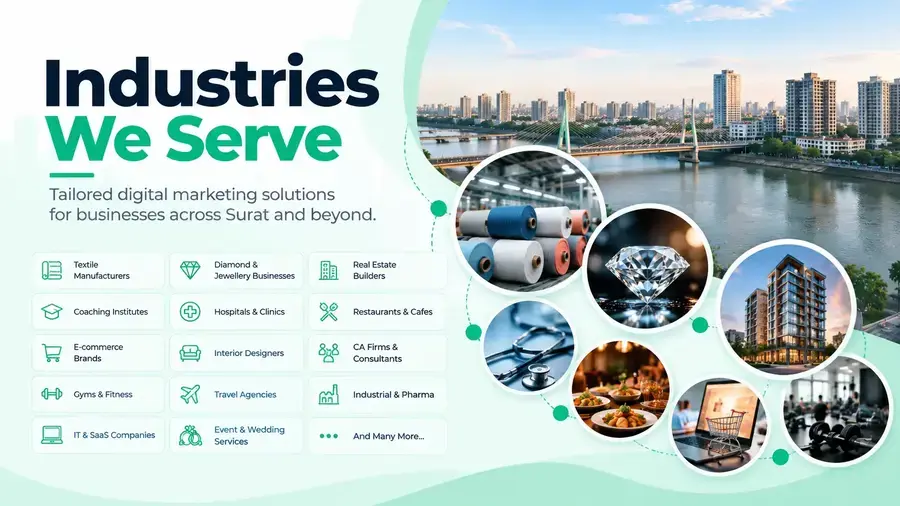
Email marketing for Surat businesses & industries
The right email program depends on how often customers buy and how much information they need before a decision.
Ecommerce, Fashion & Jewellery
Launches, product education, cart recovery, post-purchase, replenishment and customer win-back can be important lifecycle opportunities.
B2B, Manufacturing & Export
Newsletters, case studies, product updates, event communication and lead nurture can support longer sales cycles.
Real Estate & High-Consideration Services
Email can continue education after the first enquiry with project information, FAQs, proof and appointment prompts.
Education, Events & Communities
Registration communication, reminders, newsletters, updates and educational sequences can help maintain engagement.
Local & Professional Services
Useful newsletters, reminders, service education and re-engagement can keep the business familiar between purchases or appointments.
Our email marketing process
Understand the audience, clean the foundation, map the lifecycle, create the message, automate where useful, measure and improve.
Understand
Review the audience, products, sales cycle, list sources, current campaigns and business goals.
Foundation
Review opt-ins, list health, sending domain and important deliverability requirements.
Map
Define campaigns, segments and automated lifecycle journeys that deserve priority.
Create
Develop the copy, design, subject lines, CTAs and destination pages.
Build
Configure campaigns, flows, tags or integrations included in the project scope.
Send
Launch to the appropriate audience with a clear purpose and sensible frequency.
Measure
Review clicks, conversions, revenue, unsubscribes, complaints and list health in context.
Improve
Use the evidence to refine segments, content, timing, offers and future automations.
What we need from your business
Email marketing works best when the business has clear data ownership, useful content and a real customer journey behind the campaigns.
List source: where subscribers came from and what they agreed to receive.
Customer lifecycle: what happens before and after a purchase or enquiry.
Products and offers: what is worth communicating and when.
Brand assets: identity, product imagery, proof and useful content.
Platform access: existing email, CRM, ecommerce or website systems where integrations are included.
Sales and customer insight: FAQs, objections, common questions and lifecycle triggers.
Why Growth Mind Digital for email marketing in Surat?
We connect email with acquisition, conversion and retention instead of treating it as a standalone monthly newsletter.
Lifecycle thinking
We look at where the subscriber is in the customer journey and what communication is useful at that stage.
Acquisition + nurture connection
Lead generation can feed email nurture, while campaign learning can improve landing pages and follow-up.
Ecommerce + retention context
We consider the role of email after the first purchase, including post-purchase education, repeat buying and win-back.
Connected Growth Mind Digital services
Email can connect with lead generation, ecommerce marketing, WhatsApp marketing, content marketing, landing pages, CRO and social media marketing.
Email marketing pricing in Surat
Pricing depends on list size, campaign frequency, automation depth, segmentation, copywriting, email design, ecommerce or CRM integrations, deliverability work, reporting and whether the business needs one-time setup or ongoing management.
A monthly newsletter program has a different scope from an ecommerce lifecycle system with several automated flows and product-based segments.
Email-platform subscription and sending costs may apply separately depending on the tools the business uses.
No guaranteed open-rate or revenue promises
We do not promise a guaranteed open rate, click rate or revenue figure.
Performance depends on list quality, subscriber intent, offer, deliverability, content, frequency, product economics and customer behaviour.
Our role is to build a healthier email system, improve relevance and measurement, and keep learning from actual subscriber and business outcomes.
Frequently asked questions about email marketing
What does an email marketing agency do?
An email marketing agency can help with strategy, list growth, segmentation, campaign planning, newsletters, copy, design, automation, deliverability, testing and performance reporting.
Is email marketing still effective?
Email can remain valuable when the business has a relevant permission-based audience and sends useful messages. Its effectiveness depends on list quality, lifecycle fit, content and deliverability rather than sending volume alone.
Do I need permission to send marketing emails?
Businesses should use appropriate subscription and consent practices based on the recipients, message type and applicable rules. We recommend clear opt-ins and an easy unsubscribe process for marketing communication.
Do you buy or sell email lists?
No. Our service is built around permission-based audiences and customer relationships, not purchased or scraped email databases.
What is email automation?
Email automation sends messages based on lifecycle stages, events or customer actions. Examples include welcome sequences, lead nurture, post-purchase communication, cart recovery and re-engagement.
Can email marketing help generate leads?
Yes. Email can nurture existing prospects, convert subscribers into enquiries and support longer sales cycles, while acquisition channels are used to grow the permission-based audience.
Can you create email newsletters?
Yes. Newsletter strategy, copy, layout and campaign management can be included depending on the agreed scope.
Can you create ecommerce email flows?
Yes. Ecommerce flows can include welcome, cart recovery, post-purchase, product education, replenishment, win-back and other lifecycle journeys where relevant.
What are SPF, DKIM and DMARC?
They are email authentication mechanisms used to help mailbox providers verify sending domains and reduce spoofing. The correct setup depends on the sending platform and domain configuration.
Why are my emails going to spam?
Possible causes include poor list quality, missing authentication, high complaint rates, weak sender reputation, aggressive sending practices or technical configuration issues. Deliverability usually needs a broader review rather than one quick fix.
How often should I send marketing emails?
There is no universal frequency. The right cadence depends on audience expectations, category, content value, offer frequency and engagement. More email is not automatically better.
What is a good email open rate?
Open rates vary by industry, audience and mailbox privacy features, so there is no single useful benchmark for every business. Clicks, conversions, unsubscribes, complaints and business outcomes often provide better context.
Can email marketing integrate with my CRM or website?
Often yes, depending on the platforms and available integrations. CRM, ecommerce and website events can support segmentation and automated journeys where compatible connections exist.
How much does email marketing cost in Surat?
Pricing depends on list size, campaigns, automations, integrations, copy, design, deliverability and ongoing management. Platform subscription or sending costs can be separate.
Do you guarantee revenue from email marketing?
No. Revenue depends on audience quality, product or service demand, offer, customer behaviour and many other factors. We focus on building a healthier and more measurable lifecycle program.
Turn your email list into a stronger customer relationship
Build better campaigns, useful automations and lifecycle communication around people who actually chose to hear from your business.